
June 13, 2026
Public Launch, GA4 Release & Production Deployment
Google Analytics 4 Activation — Measurement ID G-XKLCTXFJPB
GA4 tracking was released from the placeholder state and activated with measurement ID G-XKLCTXFJPB. The gtag.js snippet was embedded in header.php with standard configuration for page views, session tracking, and user engagement metrics. This enables the 345tool team to monitor organic traffic growth, analyze user interaction patterns with the strength meter and password generator, and measure EEAT content engagement — all while maintaining the zero-server-passwords architecture: GA4 collects only anonymized page-level analytics, never form input data.
Improvement Suggestions Logic Optimization — Score-Gated Recommendations
The suggestions engine received a critical UX refinement: passwords scoring Strong (≥60) or above now display "Great password! No critical weaknesses detected." instead of nitpicking about missing character types. Previously, even a high-entropy 20-character lowercase passphrase would trigger "Add uppercase letters" and "Add symbols" suggestions — technically true but misleading for already-strong passwords. The getSuggestions(password, score) function now returns an empty array when score ≥ 60, short-circuiting all pattern checks. The minimum-length recommendation was also reduced from 16 to 12 characters, aligning with NIST SP 800-63B's current guidance favoring length over complexity mandates.
Mobile UX Polish — Hamburger Menu & Generator Responsive Layout
A duplicate click-handler conflict in the mobile hamburger menu was resolved: both header.php inline script and js/script.js were binding to #hamburgerBtn, causing a toggle flash where the menu opened and immediately closed. The inline script was removed, leaving only the centralized script.js handler. The password generator output row was made fully responsive with a CSS media query at 719px breakpoint: below 720px viewport width, the output field, refresh button, and copy button stack vertically in two rows for comfortable thumb access; above 720px they render in a single horizontal row.
Production Deployment — Nginx, Sitemap & Final Configuration
The aisleads.com.nginx.conf server block was finalized with production-grade settings: proper server_name aisleads.com www.aisleads.com, TLS/SSL well-known paths, gzip compression for CSS/JS assets, and PHP-FPM upstream integration. The XML sitemap was regenerated with all canonical URLs locked to aisleads.com. The robots.txt was updated with production sitemap reference and crawl rules. All structured data JSON-LD blocks across index, about, privacy, and team pages were verified for consistency against the 345tool satellite site schema standard.
June 10, 2026
EEAT Content Optimization & Mobile Responsiveness
Homepage EEAT Compliance — Full Content Rewrite with Academic Rigor
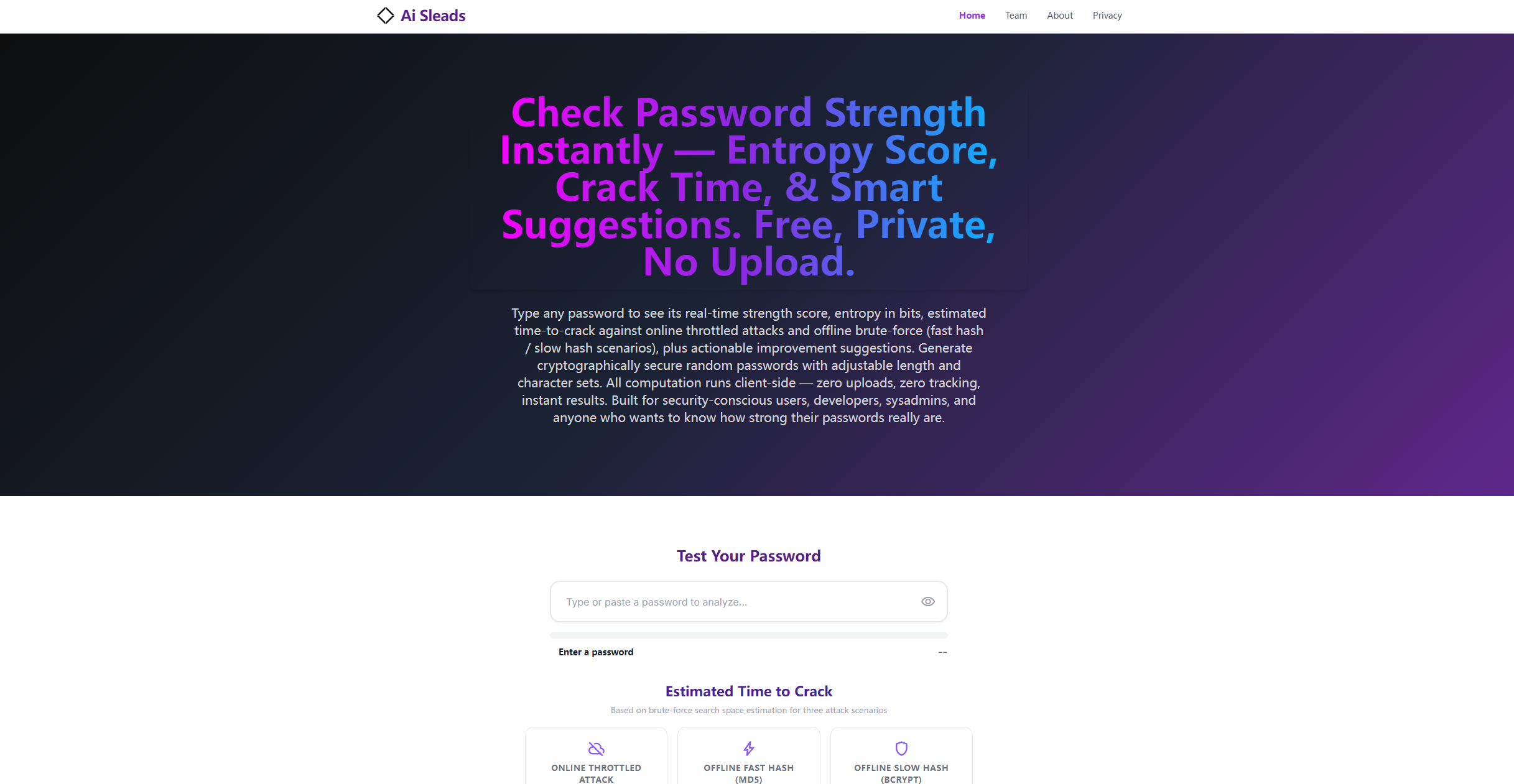
The homepage was rewritten end-to-end to satisfy Google's E-E-A-T quality guidelines for Your Money or Your Life (YMYL) security tools. The Title tag was structured as "Free Password Strength Checker — Entropy Score & Crack Time Test | Ai Sleads" targeting high-intent password analysis queries. The Meta Description (155 characters) packs entropy, crack time, and generator keywords into a single compelling snippet. The H1 was expanded to "Check Password Strength Instantly — Entropy Score, Crack Time, & Smart Suggestions" with a supporting H2 "Test Your Password" above the input field. The FAQ section was expanded from 6 to 9 question-answer pairs covering entropy mathematics, crack time accuracy, zero-server architecture, CSPRNG internals, NIST password guidelines, and the 345tool business model. All educational content was anchored with authoritative citations: NIST SP 800-63B for password policy, hashcat v6.2.6 GPU benchmarks for crack speed estimates, Verizon 2023 DBIR for breach statistics, and Microsoft 2023 DDR for attack vector analysis.
JSON-LD Structured Data — 9-Entry FAQPage Synchronization
The JSON-LD FAQPage block was expanded from 6 to 9 question-answer pairs to match the rewritten HTML FAQ content. Each Question/Answer pair mirrors the visible FAQ entries exactly, maintaining Google's requirement for structured-data-to-visible-content parity. The WebApplication type was set to SecurityApplication with operatingSystem "All" and offers free category designation. The Organization (345tool Team) and BreadcrumbList blocks were left unchanged per satellite site matrix policy.
Generator Defaults & UI Refinements
Random password generator defaults were optimized for usability: default length set to 12 characters (balancing security with memorability for password manager users), symbols checkbox defaulted to off (reducing friction for sites that restrict special characters), and lowercase + uppercase + digits pre-selected. Section titles "Estimated Time to Crack" and "Random Password Generator" were bumped to 22px for better visual hierarchy. The "Test Your Password" H2 was added above the input field with proper top padding to separate it from the hero section.
Mobile Hamburger Menu Bugfix & Responsive Layout
A duplicate event listener conflict was identified and resolved: both an inline script in header.php and the centralized js/script.js were binding click handlers to the hamburger button, causing the mobile menu to open and immediately collapse on toggle. The inline handler was removed, consolidating all UI behavior into script.js. CSS media queries at 719px breakpoint were introduced for the generator output row, ensuring the password field, refresh button, and copy button stack gracefully on mobile viewports.
June 5, 2026
Crack-Time Estimation Engine & Improvement Suggestions
Three-Attack-Vector Crack-Time Estimation Model
The crack-time estimation engine was designed to model three distinct adversarial scenarios with hashcat v6.2.6 benchmark-calibrated speeds. The online throttled attack (1,000 guesses/second) simulates a remote attacker probing a rate-limited login form — the most common real-world threat. The offline fast hash (MD5) scenario (100 billion guesses/second) models a dedicated GPU cluster with 8× NVIDIA RTX 4090 cards cracking a leaked unsalted hash database — worst-case for breaches. The offline slow hash (bcrypt) scenario (10,000 guesses/second) represents well-engineered systems using deliberately expensive key-derivation functions with cost factor 12. Each estimate uses search-space ÷ 2 for average-case (expected attempts before success), and time formatting scales adaptively across seconds, minutes, hours, days, years, centuries, and millennia.
Improvement Suggestions — Contextual, Actionable Feedback
The suggestions engine was built to provide actionable, human-readable recommendations rather than generic warnings. Pattern-specific messages target exact weaknesses: "This password appears in known breach databases" for blacklist matches, "Consider adding uppercase letters (A-Z)" for lowercase-only passwords, "Your password contains sequential characters" for runs like abc/123. Each suggestion explains the why — e.g., "Avoid keyboard walk patterns — they appear in every attacker's wordlist and are cracked instantly." The system prioritizes security-critical issues (common password, keyboard walk) over optimization suggestions (adding symbols to an already-strong password).
Strength Bar — Animated Five-Tier Color Progression
The real-time strength bar was implemented with CSS transitions on width and background-color for smooth animated feedback as the user types. Five color-coded tiers map to score ranges: Very Weak (0–20, red), Weak (20–40, orange), Fair (40–60, yellow), Strong (60–80, green), and Very Strong (80–100, dark green). The bar width scales linearly with the score percentage, creating an intuitive visual metaphor. A text label updates synchronously to show both the tier name and numeric score.
June 3, 2026
Core Engine Implementation & Multi-Layer Pattern Detection
Multi-Layer Pattern Detection — 35 Blacklist Passwords, 14 Keyboard Walks, Sequentials & Repeats
The pattern detection subsystem was built across four attack surfaces. A common-password blacklist of 35 top breached credentials (password, 123456, qwerty, iloveyou, monkey, dragon, etc.) provides instant detection of dictionary-attack-vulnerable passwords. Keyboard walk detection covers 14 patterns across QWERTY, AZERTY, and numeric keypad layouts — horizontal (qwerty, asdfgh), vertical (qazwsx, 1qaz2wsx), and diagonal walks — with both forward and reverse direction matching. Sequential character detection identifies runs of 3+ consecutive characters in both directions for letters (abc, cba, xyz) and digits (123, 987). Repeated character detection catches 4+ consecutive identical characters (aaaa, 1111) that signal low-effort padding. Each detected pattern applies a score penalty proportional to the pattern length and type.
CSS Framework — Password-Specific Component Design System
A complete CSS component library was designed for the password checker interface. Key components include: .pwd-input (large masked text field with show/hide toggle icon positioned absolutely within), .strength-meter-fill (animated gradient bar with five color states and CSS transitions), .crack-cards-grid (responsive three-column grid collapsing to single column on mobile, each card with icon + scenario name + formatted time), .suggestions-list (dynamic list with conditional visibility, each item prefixed with a warning icon and color-coded by severity), and .gen-section (integrated password generator with range slider, checkbox group, and action buttons). All components use the 345tool design token system (purple-900, purple-500, gray-600, white/80 opacity layers) for visual consistency across the satellite site network.
Brand Finalization — Ai Sleads on aisleads.com
The brand was finalized as Ai Sleads on domain aisleads.com. The header icon was locked to 32px with inline styles to prevent layout shift during page load. Open Graph and Twitter Card meta tags were configured for social-sharing previews. The footer, about, privacy, and team pages were synchronized with the new branding. The 345tool Team JSON-LD Organization block was locked across all pages per satellite site matrix policy. Google Analytics 4 was prepared with a placeholder measurement ID (G-XXXXXXXXXX) pending production deployment.
June 1, 2026
Algorithm Design, CSPRNG Generator & Platform Inception
Strength Scoring — Multi-Factor Weighted Composite Algorithm
The scoring algorithm was designed from first principles as a weighted composite of four independent factors. Base entropy score (40% weight): H = L × log₂(N), where L is password length and N is the character-set cardinality derived from runtime analysis of which character classes (lowercase=26, uppercase=26, digits=10, symbols=32) are actually present. Length bonus (capped at 30 points): each character beyond the first 8 contributes 2.5 points, reflecting the exponential growth of the combinatorial search space with length. Character diversity score (0–20 points): 5 points awarded for each of the four character classes present. Pattern penalties (subtractive): deductions for matches in the common-password blacklist, keyboard walks, sequential runs, character repetition, and type-homogeneity (single-class passwords). The raw composite passes through clamping at 0–100 and rounding to produce the final integer percentage displayed to the user. This multi-factor design ensures scores reflect both mathematical entropy (the theoretical upper bound) and real-world crackability (the adversarial perspective accounting for human password-creation biases).
Cryptographic Random Password Generator — CSPRNG via Web Crypto API
The random password generator was built on the crypto.getRandomValues() CSPRNG API — a deliberate architectural choice with profound security implications. Unlike Math.random(), which uses a deterministic pseudo-random algorithm seedable from a single 64-bit value (making it trivially predictable), the Web Crypto API draws entropy from the operating system's hardware entropy pool (/dev/urandom on Linux, CryptGenRandom on Windows), making generated passwords truly unpredictable even to an attacker with knowledge of the generation algorithm. Users control length (8–64 characters via an HTML range slider) and character sets (4 toggle checkboxes for a-z, A-Z, 0-9, symbols). A post-generation enforcement pass guarantees at least one character from each selected set, preventing the edge case where a random draw accidentally omits a required character class — which, while cryptographically valid, would confuse users who expect representation from each selected set.
Zero-Server Architecture — Privacy by Design
The platform was architected from inception with a strict zero-server-footprint mandate. Every computational operation — entropy calculation via calcEntropy(), multi-factor strength scoring via calcStrengthScore(), pattern matching across four attack surfaces, crack-time estimation with three adversarial scenarios, improvement suggestion generation, and CSPRNG password generation — executes exclusively within the user's browser as vanilla JavaScript with zero external dependencies. No passwords, no keystrokes, no analysis results, and no behavioral telemetry ever leave the device. This architecture is not merely a privacy preference; for a password analysis tool, any server-side processing would constitute a catastrophic architectural vulnerability — a single compromised server could expose every analyzed password. The tool is fully functional offline after the initial page load, requiring no network connectivity for any core operation.
Contact
— E-mail: [email protected]
— Date of creation: June 1, 2026 • Last updated: June 13, 2026

We are the 345tool Team
345tool is an independent developer collective engineering elite, pure client-side, and privacy-first web utilities to replace bloated internet tools.